Before the thieves
get in.
The raid to stop is the one that never reaches the floor.
The raid on the bank branch in Piazza Medaglie d’Oro in Naples, reported in April 2026, seemed straight out of a film: a tunnel dug by hand underground, about twelve metres long and less than one metre high, prepared over weeks. Commenting on the case for BZ News 24, I said something many found surprising: with the right sensors, the alarm would have gone off while the thieves were still beneath the floor.
Here I explain why, and what it means for anyone who keeps valuables, in a bank as in a villa.
What they are
A seismic sensor, or vibration detector, is fixed directly to the structure it protects: the walls, floor and ceiling of a vault or strongroom, or the body of a safe. It does not watch the room the way a motion detector does: it feels what travels through the material.
Every attack on a structure leaves a signature: the jackhammer, the drill, the core drill, the cutting disc, the thermal lance. The sensor analyses these vibrations, meaning how strong they are, at what frequency and for how long, and tells them apart from the ordinary vibrations of a building: traffic, a lift, a door closing.
Why they get ahead of the attack
A conventional alarm goes off when someone is already inside. A seismic sensor goes off while someone is trying to get in, because the structure carries the vibrations of the digging before the digging arrives. In the Naples case, on the information available, the alarm would have gone off at least one metre before the thieves reached the bank’s floor. Perhaps much earlier: it depends on the ground and on the speed of the digging, and the technical report would be needed to say.
A metre of earth and concrete means time. Time to verify, to alert the police, to stop the raid while those preparing it are still underground and the vault is intact. It is no longer only about defending, but about getting ahead of the attack.
Not only banks
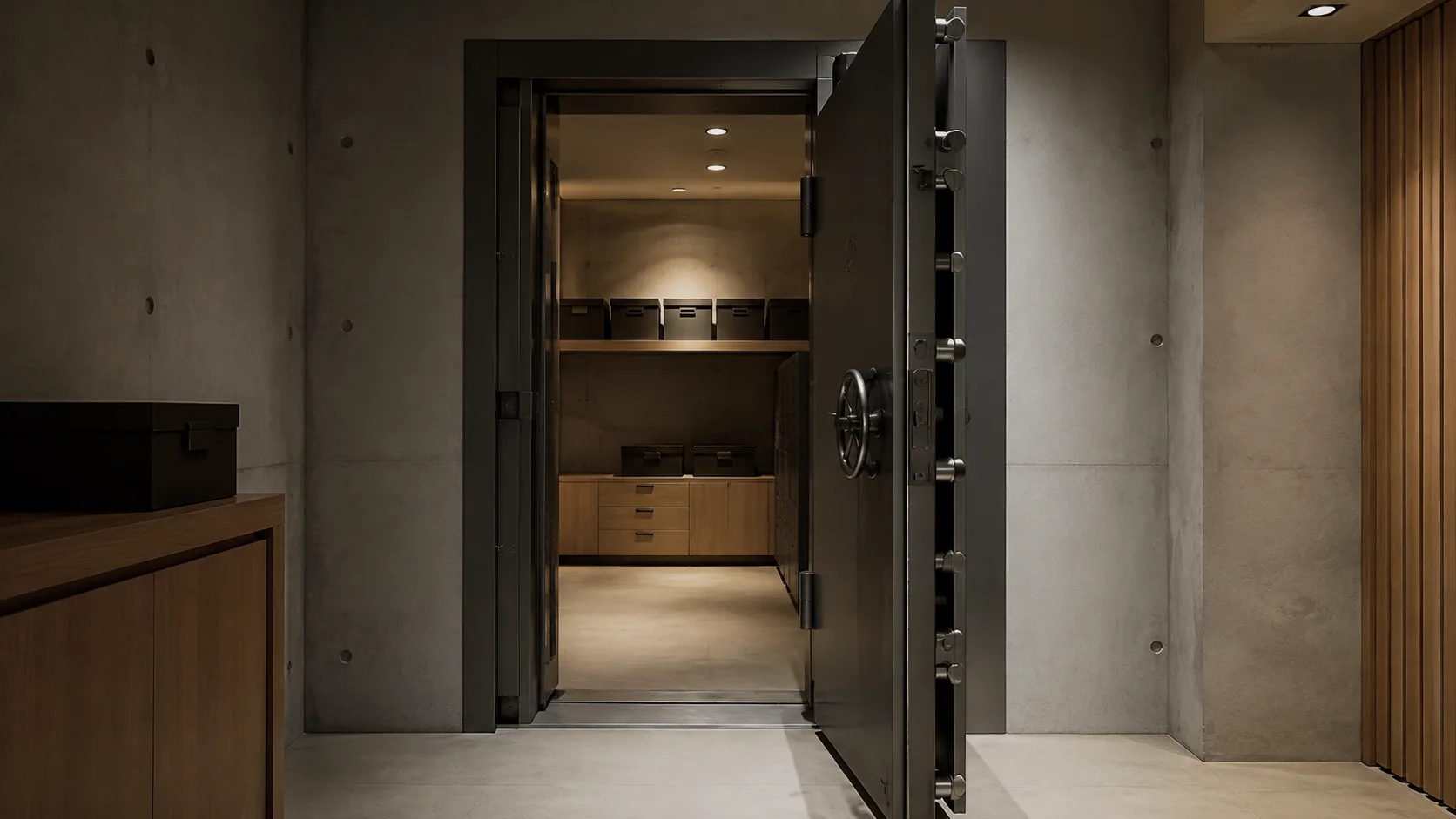
The same principles apply wherever valuables are concentrated in one place: a jeweller’s safe, a vault in a villa, the room that houses a collection, a company’s confidential archive. These places are often well protected at the door and poorly on the walls, because no one expects anyone to come through the wall. That is exactly the reasoning a raid like the one in Naples calls into question.
For a safe at home, a sensor fixed to its body gives warning if someone is forcing it or trying to tear it from the wall, even when the house has been empty for weeks.
How seismic protection is designed
Start from the structure. Wall type, thickness, material and joints decide how many sensors are needed and where: vibrations travel well through reinforced concrete, less well across joints and different materials.
Cover every side. Floor and ceiling included. A vault protected only on its walls leaves open precisely the route chosen in Naples.
Calibrate on the real building. A vault under a busy road and one in the countryside do not have the same background noise. Calibration ensures that a real attack is not missed and that pointless alarms, which would eventually cause real ones to be ignored, are not raised.
Check over time. The most serious systems include a periodic test that confirms every sensor responds. A sensor that stops working without anyone noticing is exactly the weak point a professional looks for.
Connect to those who can respond. A seismic alarm must reach someone who can verify it at once, together with images from nearby cameras and the other signals from the system. On its own, a sensor warns; within a system, it makes decisions possible.
Technology alone is not enough
As with any system, the difference lies in the method: understanding what needs protecting, from whom and from which direction, before choosing the devices. Behind every “perfect” raid there is almost always a vulnerability nobody had considered; reading it in advance is my job. The original interview is in BZ News 24 (in Italian): “I sensori sismici potevano fermare il colpo di Napoli?”.
Safes and vaults are designed with NetCom Security Group. The first consultation is free and confidential: how it works.
Frequently asked questions
Are seismic sensors useful in a home too?
Yes, when there is a valuable safe or a vault in the house. The sensor gives warning if someone is forcing the structure or trying to remove it, even when the house is empty.
Can traffic or a lift set off the alarm?
A system calibrated on site tells the signature of a tool apart from that of traffic or a lift. That is why calibration is done on the real building, not on paper.
Can they be added to an existing vault?
Yes. The sensors are fixed to the existing structure, after its material and joints have been checked.
Do they replace a conventional alarm?
No, they complement it. A conventional alarm protects the rooms; a seismic sensor protects the structure and gets ahead of the attack.